

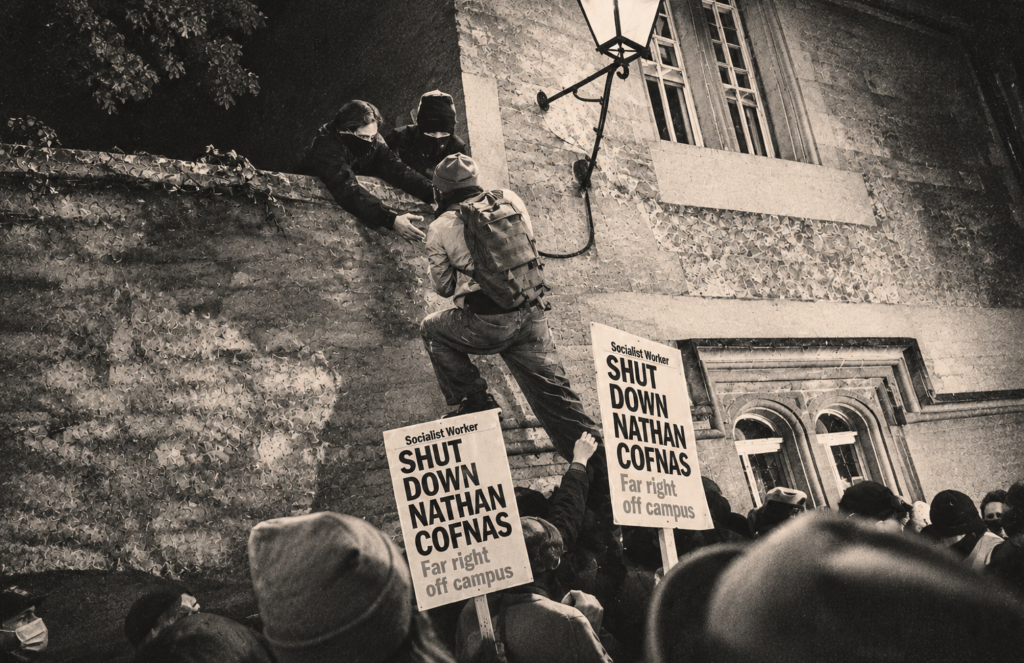
Some of the country’s finest young minds, esteemed intellectuals, principled social justice campaigners, and Jolyon Maugham gathered outside Oriel College, Oxford earlier this month to protest against a talk by the controversial “race realist” academic Dr Nathan Cofnas, entitled “Is DEI undermining higher education?”
Ahead of the event, protesters formed a mob-like cordon around the college entrances, preventing ticket holders from attending. As the event got underway, many of the protesters sporting balaclavas and keffiyehs attempted to force their way into the college, while others climbed its walls.
The Committee for Academic Freedom (CAF) also understands from well-placed sources that concerns had been raised with the police in advance about the prospect of large numbers of protesters, including the possibility that entrances would be obstructed, but that the event was nevertheless assessed as “low risk” and no police support was initially provided. Officers subsequently had to intervene once the protests escalated. According to those few ticket holders who did eventually make it inside, the noise from outside was a serious distraction throughout.
In the dry, conceptual language of free-speech jurisprudence, what this means is that although Cofnas was able to deliver his talk and engage in a Q&A afterwards, protesters partially succeeded in imposing a heckler’s veto, with some of his intended audience prevented from hearing him at all and others finding it difficult to concentrate on what he was saying.
Why such animus? Part of the explanation surely lies in Cofnas’s 2024 essay, A Guide for the Hereditarian Revolution, in which he argued that the modern obsession with eliminating racial disparities rests on a mistaken assumption that racial groups have identical distributions of innate psychological traits, an assumption he regards as the intellectual foundation of “wokism”.
On his account, accepting that assumption leads inevitably to the conclusion that unequal outcomes must be the product of discrimination, and thence to an all-consuming crusade to root out unconscious bias, microaggressions, colonial epistemologies, the miasmatic, almost spectral force of whiteness, and the institutions supposedly perpetuating them. His proposed remedy was a “hereditarian revolution” in which the intellectual establishment would embrace what he calls “race realism”; that is, the proposition that at least some of those differences reflect underlying genetic variation between populations.
But the hostility towards Cofnas has acquired another, more immediate, more visceral dimension since he published allegations of plagiarism concerning the academic work of Dr Jason Arday, then Cambridge’s youngest ever black professor, alongside a wider criticism of the university’s approach to academic appointments and diversity, equality and inclusion initiatives. Arday denied the allegations, but following sustained media scrutiny resigned from Cambridge in August. Tragically, he was found dead nine days later.
Unsurprisingly, both controversies have now become intertwined in the minds of many of Cofnas’s opponents. Is it surprising, they ask, that a man who could write that “[i]n a meritocracy, Harvard faculty would be recruited from the best of the best students, which means the number of black professors would approach 0%” would then turn his attention to exposing the alleged academic failings of a young black academic at one of the world’s oldest and most prestigious universities? And so it came to pass that, borrowing from the lexicon of racial terror in the Jim Crow South, some of his fiercest critics have gone so far as to portray his scrutiny of Arday as a campaign of persecution tantamount to the “lynching” of a black man.
For present purposes, it isn’t necessary to take a position on the merits of either Cofnas’s views or his critics’ objections (though see the lawyer Bryn Harris’s excellent discussion in The Criticfor the former). It is enough to note that his hereditarian and “anti-woke” beliefs have been found capable of protection as philosophical beliefs under the Equality Act 2010, that Oriel permitted his talk to proceed following its risk-assessment process, and that the college’s statutory duties to secure freedom of speech were engaged in relation to the event.
To be sure, protest against the ideas and beliefs of others is itself a legitimate exercise of freedom of speech. But as Article 10 of the European Convention on Human Rights (ECHR), which is given effect in domestic law by the Human Rights Act 1998, makes clear, that freedom encompasses the right to receive information and ideas as much as the right to impart them. The distinction, in other words, is not between speech and protest, but between protest and conduct that prevents others from exercising the same freedom.
That’s precisely why the Office for Students’ regulatory guidance reminds universities that protest “must not shut down debate”.
So while Oriel deserves credit for resisting pressure to cancel Cofnas’s appearance and for taking steps to ensure that the lecture proceeded, last night’s events raise an important question about the practical operation of the relatively new positive statutory duties imposed on universities and their constituent colleges by the Higher Education (Freedom of Speech) Act 2023 (HEFSA).
Under section A1 of the Higher Education and Research Act 2017, as amended by HEFSA and applied to constituent colleges by section A4, institutions must take “reasonably practicable steps” to secure freedom of speech within the law. Unfortunately, though, section A1(13) defines freedom of speech for these purposes as “the freedom to impart ideas, opinions or information”, omitting Article 10’s corresponding protection for receiving them. Article 10(1), by contrast, provides that:
“Everyone has the right to freedom of expression. This right shall include freedom to hold opinions and to receive and impart information and ideas…”
That doesn’t somehow switch off the right to receive information and ideas, which remains protected by virtue of section 6 of the Human Rights Act 1998, making it unlawful for a public authority to act incompatibly with a Convention right. But it does mean that the right to receive does not independently benefit from the additional statutory protections conferred by HEFSA, including the positive duty to take reasonably practicable steps to secure freedom of speech and the statutory OfS free-speech complaints scheme.
So where does this leave us in cases like Cofnas’s, where security arrangements on the night prove inadequate, with protesters preventing some ticket holders from attending and seriously disrupting the proceedings for those who do get inside?
Does a university or college discharge its statutory duty merely because a controversial event goes ahead, as Cofnas’s did at Oriel, with a speaker standing at a lectern producing sounds that only occasionally reach an audience too distracted or intimidated to make sense of them? Or if a willing audience is prevented from hearing the speaker by repeated and foreseeable interruptions, does that not also affect the speaker’s opportunity to communicate, that is, to impart information and ideas? If so, securing that freedom may require reasonably practicable steps to ensure that the intended audience can attend and hear the speaker without serious disruption.
The two rights – to impart and to receive – remain legally distinct. But their effective exercise is surely intimately connected, nowhere more so than where a controversial event attracts protests intended to prevent it from taking place. This interdependence is particularly significant in light of the well-established Convention principle that rights must be “practical and effective”, rather than “theoretical and illusory” (see, for example, Bradshaw and Others v the United Kingdom (2025), §128).
These are questions that, sooner or later, a High Court judge is likely to have to confront in judicial review proceedings. Parliament deliberately confined HEFSA’s additional statutory protections to the right to impart information and ideas, so a court couldn’t simply disregard that distinction. But might it conclude that, in circumstances such as these, the duty to secure a speaker’s freedom to impart ideas cannot be discharged without taking reasonably practicable steps to protect the audience’s opportunity to receive them?
More immediately, though, last week’s events provide good grounds for a review of the arrangements Oriel made in advance, the liaison between the college and the police, whether the assessment of the risk as “low” was at all plausible, and whether those arrangements afforded ticket holders a reasonable opportunity to attend, notwithstanding the anticipated protests. Any such review should also consider what additional steps might be necessary to protect that opportunity at future events.
The statutory duty to secure freedom of speech is there for every visiting speaker – “race realist” or EDI advocate, gender-critical or pro-trans, pro-Palestine or pro-Israel – irrespective of their popularity or the perceived offensiveness of the lawful views they express. That’s why we need a much clearer understanding of what these duties mean in practice, so that the exercise of freedom of speech on campus doesn’t end up depending on which side of a controversial argument can mobilise the greatest number of balaclava-clad, black bloc-style protesters outside a university venue.